
If you’ve been considering buying a new laptop, PC, or phone over the past few months, you’ve likely noticed that things have become significantly more expensive. RAM, or Random Access Memory, plays a major role in this. Its price has risen so rapidly over the past eighteen months that people have even called it the “RAMpocalypse.” What had been becoming cheaper year after year for decades has suddenly become a luxury item. Let’s understand what’s happening.
Table of Contents
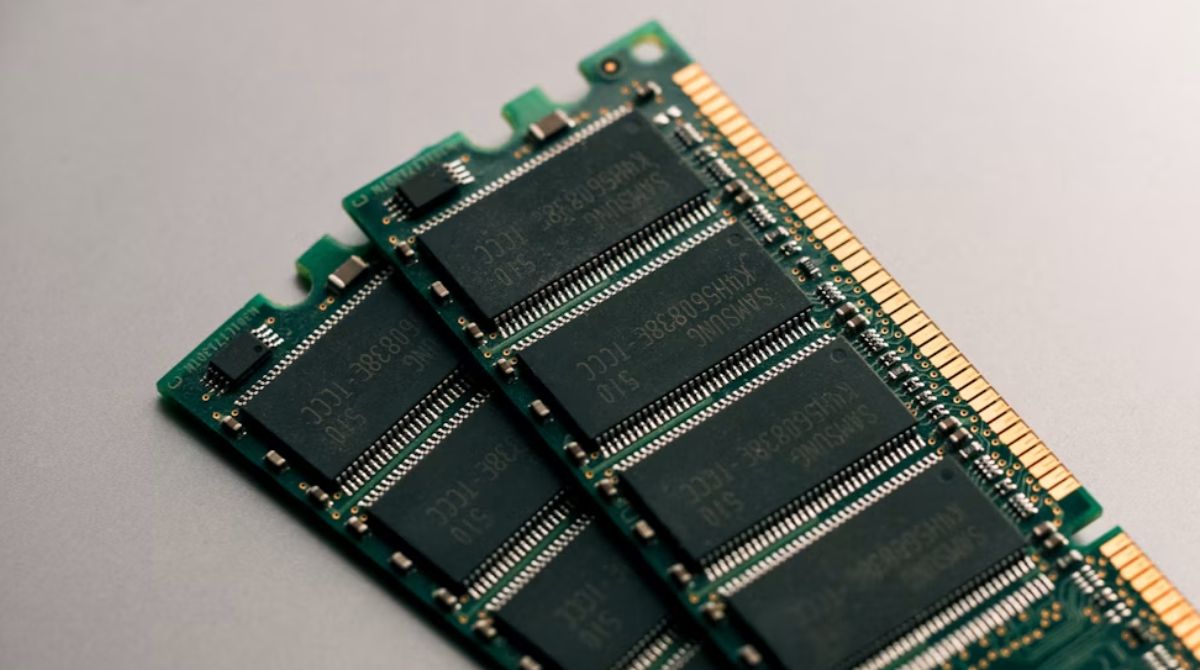
Photo: unsplash.com
What is RAM and why is it important?
Simply put, RAM is the part of your computer that instantly provides the CPU with the data it needs to function. No matter how fast your hard drive or SSD is, it can’t keep up with the CPU’s speed. So, RAM acts as a bridge. It pulls important files from storage and keeps them ready for the CPU to use. The more RAM you have, the more data will be “ready,” and the smoother the system will run. This is why experts always recommended increasing RAM first if your computer was running slowly, at least until this whole crisis started.
Who makes RAM?
Just three companies manufacture almost all of the world’s RAM: Samsung, SK Hynix, and Micron. These companies operate multi-billion-dollar factories where the level of engineering precision is as complex as rocket science. There are also several types of RAM, such as DDR (Double Data Rate) for PCs, and Low Power DDR (LPDDR) for mobile devices.
But there is another type which is the main reason for this entire crisis. HBM i.e. High Bandwidth Memory. It is much more advanced and faster than normal DRAM, and is used for AI training in data centers. Interestingly, both DRAM and HBM are made from the same silicon wafer, they are just connected in different ways. The problem is that making HBM requires a lot more resources. According to Micron CEO Sanjay Mehrotra, making one unit of HBM requires almost three times more wafer supply than normal DDR5 RAM. This means that for every unit of HBM produced, the supply of consumer RAM decreases by the same amount.
Read More; Apple Spyware Warning: iPhone Users Beware of Mercenary Spyware Attack
How much has the price increased?
Look at data from price-tracking websites like PCPartPicker So the picture is quite striking. A pair of 16GB DDR5-4800 units, which used to be available for less than $100 in early 2025, now exceeds $400. Meanwhile, a high-end 32GB DDR5-6000 kit, which used to cost around $250, now exceeds $1,200. That’s the equivalent of an entire MacBook Air.
The real reason: The AI boom
The biggest reason for this entire crisis can be summed up in one word: AI. To elaborate, the global RAM market has been highly predictable for the past two decades. Companies used to know in advance how many phones and PCs would be sold in a year, and supply was planned accordingly. But now, AI companies, with huge investor funds, have bought up entire factory production capacities. According to reports, manufacturers’ RAM production capacity until 2027 has already been sold.
To understand its scale, consider xAI’s Colossus data center in Memphis, which houses approximately 550,000 NVIDIA GPUs, valued at over $18 billion. This facility alone uses enough RAM to equal the combined RAM of approximately 14 million iPhone 17s or 93,000 Samsung Galaxy S26s. Hundreds of such data centers are currently under construction worldwide. Similarly, a major partnership deal between OpenAI and AMD is underway, creating multi-gigawatt AI data centers. And the demand for RAM is equally enormous.
The simple calculation is this: the RAM that used to power ordinary laptops and phones is now being used in AI data centers. And companies are willing to secure supplies at any cost to meet this demand.
Read More:
- France’s top court strikes down social media ban on children under 15
- DeepSeek AI models will now be four times more expensive
How long will RAM be cheap?
The bad news here is that there is little chance of getting relief soon. SK Hynix CEO Kwak Noh-jung said in an interview that the situation could get worse in 2027, and demand will continue to exceed supply even after 2030. Micron’s CEO also told investors that “tight conditions” could persist until 2027-28. Consulting firms like Deloitte believe that there is little hope of any significant relief from this crisis before 2030, unless the AI bubble bursts soon.
Why don’t companies set up new factories?
This question comes to everyone’s mind. If demand is so high, why don’t Samsung, SK Hynix, and Micron open new factories? The answer is it’s not that simple. Building a new RAM plant takes billions of dollars and many years, because it requires extremely precise conditions, where there must be no more than one dust particle in a cubic foot of air. SK Hynix has committed to building two new factories in South Korea, costing over $38.1 billion, but production is not expected to begin before 2029.
And here’s another truth: These companies are in no hurry to end this crisis. HBM is significantly more profitable than DRAM, and AI companies are willing to pay a hefty price for it. Micron even shut down its consumer-facing RAM brand “Crucial” at the end of 2025 to focus solely on large AI customers. And this strategy has been quite successful for these companies. Micron recently reported quarterly revenue of $28.86 billion, while SK Hynix’s operating profit increased 557% year-over-year. Samsung also reported “all-time high” revenue and profit in its memory division.
What should you do buy now or wait?
If you really need RAM, whether building a new PC or upgrading, it’s not wise to wait long, as prices may rise further over the next few years. However, if you don’t need it immediately, it’s best to avoid panic buying, as this could worsen the crisis. For now, patience seems the most prudent approach in the RAM market until the AI boom calms down or new factories resume production.
Read More: