Table of Contents
The day after the results were declared, I received a call from Anil, a friend like a younger brother. There was more nervousness than joy in his voice. He said, “Dai, I’ve passed +2. What should I do now? At home, Dad says engineering, Mom says doctor, and my friends say let’s go abroad.”
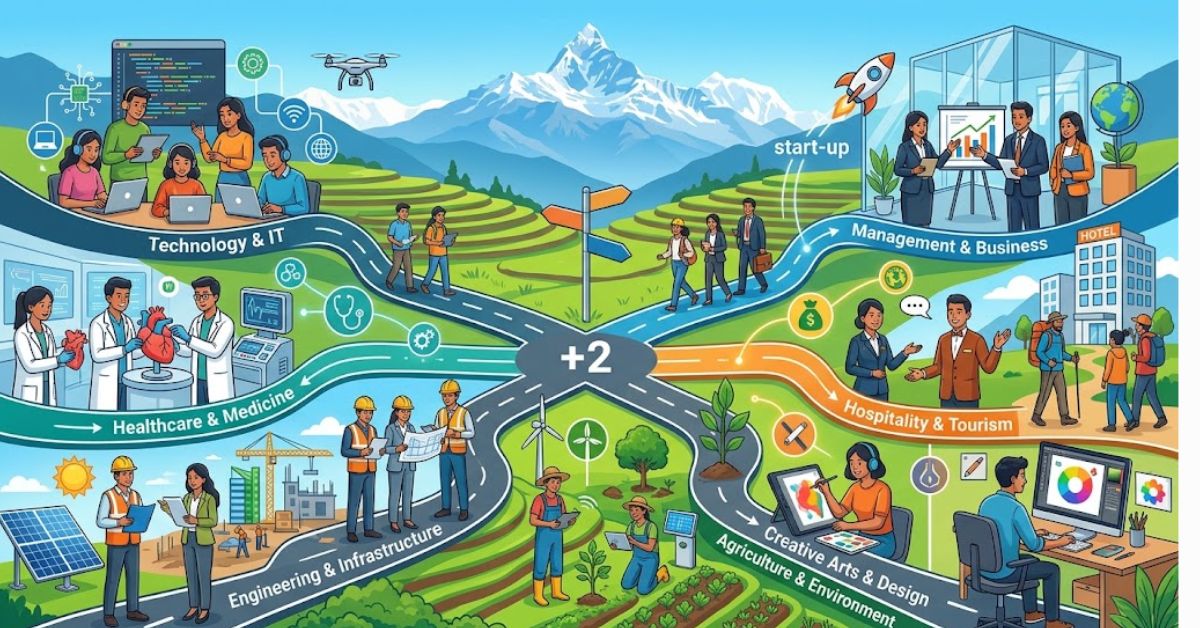
If you’re wondering this, you’re not alone. Thousands of students find themselves at this crossroads every year after their +2. In this article, we’ll explain the best career options available after +2 in Nepal in simple terms, so you can choose the right path for yourself instead of following the crowd.
First, ask yourself three questions.
Before looking at options, think honestly about these three things:
- What work do I like to do?The subject in which you do not realise the time while studying, that is your indication.
- What is my financial situation?Some courses are expensive, and this fact shouldn’t be overlooked. Also, consider scholarship and education loan options.
- Where do I want to see myself in five years?In Nepal, or abroad, or while doing your business?
The answers to these questions already make half the decision easier.
Read More: How to Prepare for TSC Exam: Complete Strategy & Tips
1. Engineering (for those in the science stream)
Nepal offers bachelor’s degrees in civil engineering, computer science, electrical engineering, electronics, and architecture. Job prospects are good in hydropower, road engineering, construction, and information technology. Many colleges conduct entrance exams, so develop a strong grasp of mathematics and physics during your secondary education. Be sure to check each college’s accreditation and seat availability before applying.
2. Health Sector: From MBBS to Nursing
Becoming a doctor is a popular dream, but MBBS and BDS seats are limited and competition is fierce. This doesn’t mean the healthcare sector is closed. Also, consider these options:
- B.Sc Nursing and Staff Nursing
- Pharmacy (B.Pharm)
- Medical Lab Technology (MLT)
- Public Health (BPH)
- Physiotherapy, Radiography and Optometry
There is a constant demand for healthcare workers both in Nepal and abroad, so these sectors are considered quite reliable.
3. Management and Business Studies
Courses like BBS, BBA, BBM, and Hotel Management are popular among management students. Banks, insurance companies, financial institutions, tourism, and private companies hire people from these fields. If you dream of starting your own business, a business degree gives you a solid understanding of accounting, marketing, and management.
Read More: How to increase organic traffic on utility website?
If you’re interested in accounting, you can pursue a Chartered Accountancy (CA) course. It’s challenging, but hard work pays off.
4. IT and Computer Science
BCA, BIT, BSc CSIT, and computer engineering are the most popular options today. Web development, app development, data analysis, cybersecurity, and digital marketing offer remote work opportunities for Nepali companies as well as foreign clients.
The special thing about this field is that along with the degree hereSkillShe speaks the most. Create your own projects, take online courses, and build your portfolio while you’re in college.
Read More: How to Run Google Ads in Nepal with Dollar Card
5. Education and preparation for government service
Earning a B.Ed. from the Faculty of Education is a respected and stable path to becoming a teacher. To become a permanent teacher in government schools, you must pass the Teacher Service Commission exam.
Different positions have different eligibility criteria for the Public Service Commission exams. Graduation is required for many positions, so complete your graduation first and start preparing simultaneously. Be sure to review the eligibility requirements on the Commission’s official website when the advertisement is released.
6. Law (LLB)
Law is a good choice for those interested in justice, human rights, business law, and politics. It opens up avenues such as advocacy, legal advisory, judicial service, and research. A good reading habit and reasoning skills are crucial.
7. Agriculture, Forest and Environment
A large portion of Nepal’s population remains engaged in agriculture, so the importance of studying agricultural science, forestry, veterinary, and environmental science remains important. Opportunities abound in government departments, non-governmental organizations, and private agricultural companies. The possibilities are even greater for those pursuing organic farming and agri-entrepreneurship.
Read More: How to Download Nepal National Identity Card Online
8. Security forces and aviation
There are opportunities to apply for various positions in the Nepal Army, Nepal Police, and Armed Police Force even after completing +2. Preparation for both physical fitness and written exams is required. Similarly, in the aviation sector, there are options such as pilot training, airline service, and airport management. Seek accurate information about positions and qualifications from the relevant organization’s advertisement.
9. Diploma and Vocational Training (CTEVT)
Not everyone needs a four-year degree. Diploma courses accredited by the Council for Technical and Vocational Education and Training (CTEVT) provide skills in a short period of time. These courses are popular in areas such as engineering diplomas, health care, agriculture, and hotel and tourism. This is a wise path for those looking to start working quickly.
10. Study Abroad
Countries like Australia, Japan, Korea, the UK, the US, and Canada are among the choices of Nepali students. However, caution is crucial here:
- Get college and visa information only from official sources.
- Don’t fall for the false promises of agents.
- Calculate the total expenses, accommodation expenses and plans after returning.
- Prepare for language tests (IELTS, JLPT, TOPIK, etc.) in advance.
Going abroad is not a bad idea, but it should not be a hasty decision.
11. New Age Options: Freelancing, Content, and Skills
There’s a growing number of Nepali youth learning from home to pursue jobs like graphic design, video editing, content writing, digital marketing, and translation. These don’t require a specific degree, but rather a habit of continuous learning and patience. It’s a good option to pursue these alongside your studies.
Read More: How to Download Nepal National Identity Card Online
How to choose the right course and college?
- of the collegeRecognitionCheck (from the university or concerned council).
- Talk to former students who studied there.
- Look at the quality of labs, libraries and teachers.
- Ask clearly about the total fees and hidden costs.
- Don’t be influenced only by advertisements and glamour.
Common mistakes to avoid
- Choosing a course just because your friends are doing it.
- Completely suppressing either the family’s wishes or one’s own interests.
- Trusting an agent without checking.
- Falling into the superstition that “this sector will always sell” is the key to real capital in every field.
- Keep postponing the decision until the last date is over.
Read More: How to Register Nepal National ID Card Online ? (2026)
In conclusion: Anil’s story
Anil thought for a few days, talked to his teachers, visited two colleges and saw everything for himself, and then chose the computer field. Today, he is learning on the job at a company and says, “The biggest relief was that I chose my own path.”
There’s no single “best” career after your 2nd year. The one that matches your skills, interests, and circumstances is the best fit for you. So don’t panic. Gather information, ask people, and then take the plunge with confidence.
Best wishes for your bright future!If you found this article useful, please send it to a friend who is confused after +2.
Which is the best course after +2 in Nepal?
The one that matches your interest, ability and budget.
What are the options after +2 science in Nepal?
Engineering, MBBS and allied health, nursing, IT, agriculture and pharmacy.
What can I do after +2 management?
BBS, BBA, BBM, hotel management, CA and banking careers.
Is studying abroad after +2 a good idea?
Yes, if you have verified information, a proper budget and a clear plan.